Airbnb Co-Host Agreement Template: Tasks, Pay and Access
A co-host helps a property owner run a short-term rental, and a short written agreement that covers tasks, pay, access and communication is the best way to keep that relationship working. This guide explains what co-hosts do, the pay models in use, and an outline you can adapt. It is a template only, not legal advice; ask a qualified professional to review any agreement for your location.
What a co-host does
The owner stays responsible for the property. The co-host handles agreed tasks, which can include:
- Guest communication: inquiries, messages and issues.
- Listing management: descriptions, photos, calendar and pricing updates.
- Check-in and check-out: meeting guests or managing digital entry.
- Cleaning and turnover: doing it or coordinating cleaners.
- Restocking and supplies.
- Maintenance coordination: contacting repair people.
- Reviews and reporting.
Be specific about which of these the co-host owns. "Everything" is the most common source of misunderstanding.
Pay models
| Model | How it works | Good for | Watch for |
|---|---|---|---|
| Percentage of booking income | A share of each booking | Full-service roles | Define "income" (before or after fees and cleaning) |
| Flat fee per booking | Fixed amount per stay | Simple tasks like check-ins | Short stays cost the owner more |
| Hourly or per task | Pay for time or specific tasks | Occasional help | Track the hours |
| Monthly retainer | Fixed monthly payment | Ongoing, predictable work | Define the expected workload |
Whatever model you choose, write down how and when payment happens and who covers supplies.
Agreement outline
- Parties and property: names and the address.
- Start date and term: when it starts, whether it renews, and how either side can end it (notice period).
- Scope of work: a list of tasks the co-host owns and tasks that stay with the owner.
- Response times: for example, replies to guests within a set time and urgent issues the same day.
- Pay: model, amount, what it is calculated on, payment date and method.
- Expenses: what the co-host may spend without approval, a spending limit and how receipts are shared.
- Access and security: keys, codes, the platform account and what can be changed.
- Pricing and calendar authority: who may change rates, minimum stays and blocks.
- Guest issues and damage: who handles complaints, claims and insurance contact.
- Reporting: how often the co-host reports on bookings, tasks and expenses.
- Privacy: protecting guest information.
- Ending the arrangement: handover, return of keys and final payment.
- Signatures and date.
Include the line: Template only, not legal, tax or accounting advice. Check your local rules.
Choosing and working with a co-host
- Start small with one property and a trial period.
- Check references and ask for past examples of their work.
- Share your house manual and standards, so they know what you expect. The house manual guide helps you write it down.
- Share your turnover checklists so quality is consistent.
- Meet or call regularly during the first month.
Tracking results together
A co-host agreement works best with visible numbers. Share a monthly summary: nights booked, income, costs, co-host pay and what is left. If the pay depends on a percentage, both sides can check the math. See what you actually keep after fees for how to calculate it.
Common problems and how an agreement prevents them
Unclear scope. The owner assumes the co-host will handle a plumbing emergency at midnight; the co-host assumed only guest messages. Fix: list tasks, and list explicitly what is out of scope, including after-hours work and who pays for emergency call-outs.
Pay disputes. A percentage sounds simple until a booking is canceled, refunded or extended. Fix: state what the percentage is calculated on, when it is paid and what happens when a booking changes.
Pricing changes without notice. A co-host who can edit the calendar can also lower rates by mistake. Fix: set a floor price or ask for approval above or below agreed limits.
Guest complaints. Who answers, who refunds and who decides when something goes wrong? Fix: write a short escalation path: the co-host handles the first response, the owner approves any compensation above an agreed amount.
Access that never gets removed. Codes and account permissions stay active long after the work ends. Fix: list every access you grant, and remove each one on the final day.
A simple monthly review
Once a month, sit down for fifteen minutes with a one-page summary: bookings and nights, income and costs, tasks completed, issues and anything to change next month. Short, regular reviews catch small problems before they become disputes, and give a co-host a fair chance to show the value of the work.
If you are becoming a co-host
- Write down your services and prices.
- Agree what you can and cannot decide alone.
- Keep your own records of work and time.
- Learn the owner's goals and style before changing anything.
- Be clear about insurance and liability, and ask a professional if unsure.
Tools that help
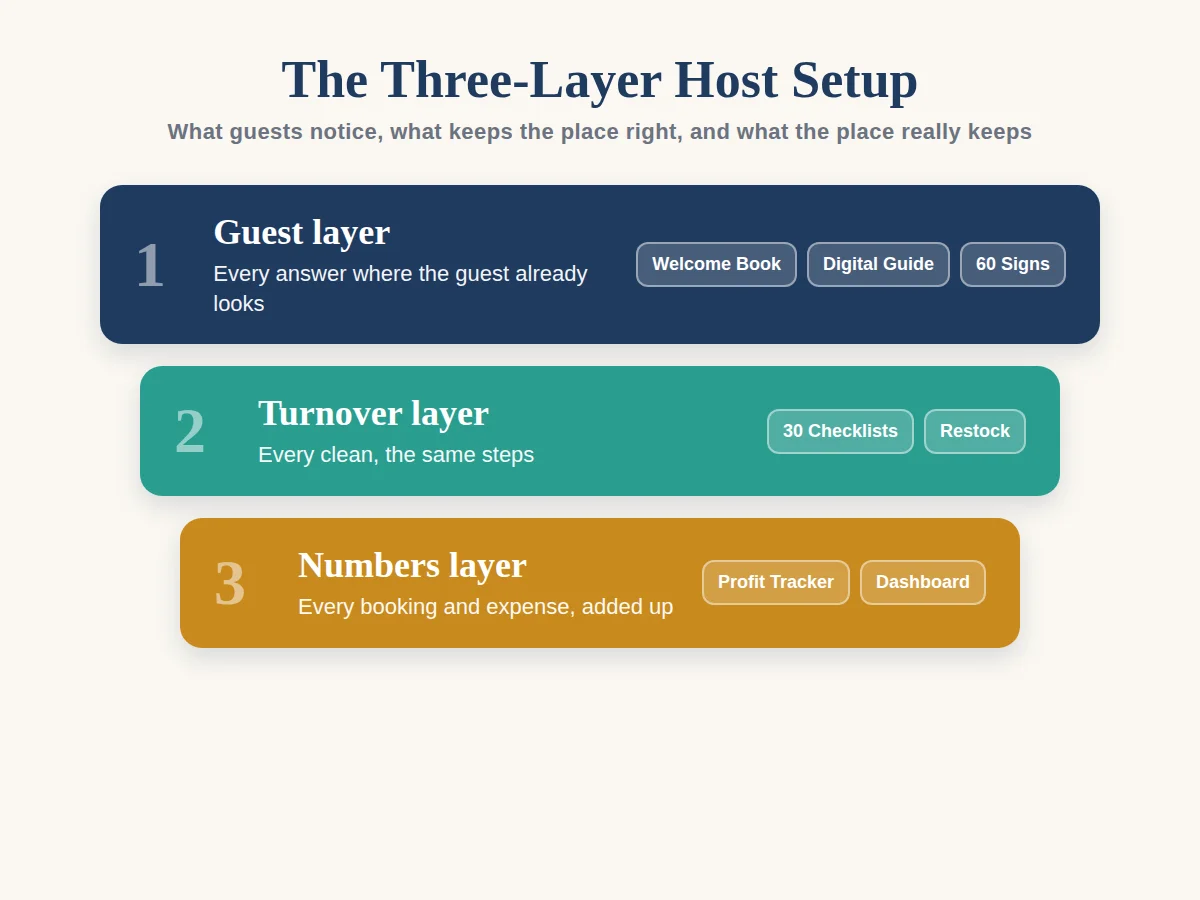
The Stayworks Host Kit includes 30 turnover and cleaning checklists you can hand to a co-host or cleaner, a printable welcome book and house manual content to document your standards, and a Host Profit Tracker you can use to review results together. A separate turnover and co-host scheduler for multiple properties is offered as an optional add-on after checkout. The kit is $19.00 one time. Nothing here is legal advice, and the agreement outline is a starting point only.
Quick checklist
- Define tasks and pay in writing.
- Set access and spending limits.
- Agree on reporting.
- Share your standards and checklists.
- Have a professional review the final text.